Monday, April 21, 2014

How to Love your neighbour


How Missionaries Are Changing Medicine
Image: William Haun / IMB / Baptist Press
Mississippi pediatrician Hannah Gay has done something never accomplished before: She has apparently cured a baby born with the AIDS virus. The final verdict is still out, but the child has been off antiretroviral drugs for two and a half years, with only traces of HIV remaining.
Gay is not just a pediatrician, but also a former Southern Baptist missionary to Ethiopia. As such, she has made just one of many significant discoveries by current and former medical missionaries worldwide.
Such contributions are not new. In the 1950s and '60s, Irish doctor Dennis Burkitt identified a new type of cancer that came to be called "Burkitt's lymphoma" while investigating jaw tumors in Ugandan children. Jack Hough, who played a key role in the founding of global Christian health organization MAP International, was a pioneer in microscopic ear surgery. Surgeon Paul Brand earned acclaim for his innovative treatments of leprosy patients in India.
Russ White's research on esophageal cancer at Tenwyck Hospital in Bomet, Kenya, is a current example. By placing a stent inside tumors, he has successfully treated the region's most common malignancy.
"Christian-inspired missionaries and nationals [have] made a huge contribution to global health," said Ray Martin, director of Christian Connections for International Health. He expects to see additional progress.
Research faces less red tape in the mission field, says David Stevens, CEO of the Christian Medical and Dental Associations and a former missionary to Kenya. And an "enormous renaissance" in doctors doing medical missions has increased the opportunity for research.
When Stevens went to Kenya in 1980, he was one of only 3 doctors at his hospital; today there are 17. "[This] gives you … more time to deal with issues and try innovative solutions."
Attendance at the Global Missions Health Conference in Louisville, Kentucky, has ballooned more than tenfold over the past 16 years. Meanwhile, attendance at the Christian Community Health Fellowship conference has quadrupled over the past four years. And the Southern Baptist Convention's International Mission Board reports an all-time high of 300 medical missionaries on the field.
"God is calling some of the best and brightest healthcare personnel to some of these difficult-to-reach areas," said Stevens. "So it's not surprising that they're coming up with some of these innovations."

Hippocratic oaths

https://www.nlm.nih.gov/hmd/greek/greek_oath.html


History of Medicine
National Library of Medicine
National Institutes of Health
Greek Medicine
I swear by Apollo Physician... Greek Medicine from the Gods to Galen

The Hippocratic Oath


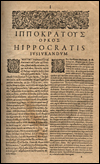
Page showing the Hippocratic Oath in Greek on the left and in Latin on the right, from: Hippocrates. Ta euriskomena ... Opera omnia … (Frankfurt: The heirs of Andreas Wechel, 1595).  NLM Call number: WZ 240 H667 1595.
The Hippocratic Oath (Ορκος) is perhaps the most widely known of Greek medical texts. It requires a new physician to swear upon a number of healing gods that he will uphold a number of professional ethical standards. It also strongly binds the student to his teacher and the greater community of physicians with responsibilities similar to that of a family member. In fact, the creation of the Oath may have marked the early stages of medical training to those outside the first families of Hippocratic medicine, the Asclepiads of Kos, by requiring strict loyalty.
Over the centuries, it has been rewritten often in order to suit the values of different cultures influenced by Greek medicine. Contrary to popular belief, the Hippocratic Oath is not required by most modern medical schools, although some have adopted modern versions that suit many in the profession in the 21st century. It also does not explicitly contain the phrase, "First, do no harm," which is commonly attributed to it.

Hippocratic Oath

I swear by Apollo the physician, and Asclepius, and Hygieia and Panacea and all the gods and goddesses as my witnesses, that, according to my ability and judgement, I will keep this Oath and this contract:
To hold him who taught me this art equally dear to me as my parents, to be a partner in life with him, and to fulfill his needs when required; to look upon his offspring as equals to my own siblings, and to teach them this art, if they shall wish to learn it, without fee or contract; and that by the set rules, lectures, and every other mode of instruction, I will impart a knowledge of the art to my own sons, and those of my teachers, and to students bound by this contract and having sworn this Oath to the law of medicine, but to no others.
I will use those dietary regimens which will benefit my patients according to my greatest ability and judgement, and I will do no harm or injustice to them.
I will not give a lethal drug to anyone if I am asked, nor will I advise such a plan; and similarly I will not give a woman a pessary to cause an abortion.
In purity and according to divine law will I carry out my life and my art.
I will not use the knife, even upon those suffering from stones, but I will leave this to those who are trained in this craft.
Into whatever homes I go, I will enter them for the benefit of the sick, avoiding any voluntary act of impropriety or corruption, including the seduction of women or men, whether they are free men or slaves.
Whatever I see or hear in the lives of my patients, whether in connection with my professional practice or not, which ought not to be spoken of outside, I will keep secret, as considering all such things to be private.
So long as I maintain this Oath faithfully and without corruption, may it be granted to me to partake of life fully and the practice of my art, gaining the respect of all men for all time. However, should I transgress this Oath and violate it, may the opposite be my fate.
Translated by Michael North, National Library of Medicine, 2002.


Introduction
Olympian Healers
Hippocrates
Aristotle
Galen
Other Physicians

The corruption of modern medicines


Just as we live in a fallen world, our medical system has fallen.  Our doctors today are not practicing the same kind of medicine as Luke the physician did in the Bible.  In the early 1900s, our medical system was corrupted by the Rockefellers, the Carnegies, and others who discovered that there was much money to be made from medicine.  They made it their goal to make allopathic medicine the only acceptable medical treatment, and to shut down any natural or alternative treatments that were available. Their goal was to keep people dependent on allopathy and drugs — the big money makers.  A short video I am including here describes briefly what happened.  It’s most interesting to note that while this was going on, John D. Rockefeller was putting all of his money into allopathic care, while seeking only homeopathic care for himself.
Please don’t misunderstand me.  I know a lot of amazing people that work in our healthcare industry.  Amazing doctors, amazing nurses, and I know there are some amazing medicines that do a lot of good.  I have some great Christian friends that are nurses whom I love dearly.  They are in healthcare for the right reasons.  There is a time and a place for seeking medical treatment and hospitals are indeed necessary in our world. God CAN use medicine to help us.  What I am saying is that we have got to stop blindly trusting the medical industry, and start praying for wisdom and discernment when seeking medical care.  We have to stop reacting in FEAR and start dropping to our knees in prayer and trusting God fully.  We need to actively pray for God to open our eyes to what truly is good for us and bad for us and stop believing that things are good just because the CDC or the AAP say that they are.  The Bible says that all men are liars (Psalm 116:11 and Romans 3:4); so why are we trusting that we are always being told the truth by the “experts”?  Are we blindly trusting in “science” without realizing that behind “science” is a scientist who is also a fallen, imperfect human being?

Wednesday, March 26, 2014

Symbols used in Medicine and it's origin


SYMBOLS IN MEDICINE

Origin of three symbols in medicine and surgery
Lorenzo de la Garza-Villaseñor
Abstract
Background: Humans use many ways to communicate with fellow humans. Symbols have been one of these ways. Shamans probably used these in the beginning and adopted other distinctive symbols as they were introduced.

Discussion: The origin, the reason and use of three symbols in medicine and surgery are discussed. Some symbols currently remain the same and others have been modified or have disappeared. 

The oldest of these three symbols is the staff of Asclepius, related to the Greek god of medicine and health. Since the 19th century, in some countries the symbol of the medical profession has become the caduceus, but the staff is the natural symbol. 

The second symbol is the barber pole that was created at the beginning of the Middle Ages. This was the means to locate the office and shop of a barber/surgeon in towns, cities and battlefields. On the other hand, the surgeon made use of the emblem of the union, trade or fraternity to which he belonged, accompanied by the bowl for bloodletting. 

The third symbol is the wearing of long and short robes that distinguished graduate surgeons from a medical school and the so-called barber/surgeons.

Conclusions: Symbols facilitate the manner in which to identify the origin or trade of many working people. Some symbols currently remain and others have either been modified or are obsolete, losing their relationship with surgery and medicine.
…………………………………………………………………………………………………………………………………
The bronze serpent and the Lord´s  crucifixion are related (John 3:14-16):
“And just as Moses lifted up the serpent in the desert, so must the Son of Man be lifted up, so that everyone who believes in him may have eternal life.”
For God so loved the world that he gave his only Son, so that everyone who believes in him might not perish but might have eternal life.
………………………………………………………………..

LOve: God's medicine

http://www.keepbelieving.com/sermon/2007-01-07-Gods-Medicine-for-a-Sick-World/

God’s Medicine for a Sick World – Romans 13:8-10

MORE FROM THIS SERIES

MORE RESOURCES LIKE THIS

Questions about the sermon
Sermon 9 of 21 from the The Transformed Life (Romans 12-16) series
January 2007 – “Love is the medicine for the sickness of the world.” So said noted psychiatrist Dr. Karl Meninger. He summarized his therapeutic approach this way: “Love cures. It cures those who give it and it cures those who receive it.”

Love truly is good medicine. It has been said that the three most powerful words in the English language are “I love you.” When I returned to my office one day, I noticed that the voicemail light on my phone was lit. The message came from a man in another state. He called to tell me about some of the difficulties in his own life and how he was dealing with them. Along the way he mentioned that he had poured out his heart to his mentor and had told him the whole ugly story of what he had done. When he was finished, his mentor simply replied, “I want you know that I love you.” Then the man said, “Pastor Ray, I can’t tell you what it meant for him to listen to my story and then to say ‘I love you.’”
Such is the power of love. I know that our society sometimes confuses love with sex or with money or with gifts. Many people don’t understand love and are even afraid of it because they’ve never seen the real thing. But even with all our counterfeits, and even with all the misunderstanding, and even in spite of the abuses committed in the name of love, it is still true that what the world needs now is love, sweet love. And not just the word “love,” we need the real thing. We need to see love and to hear it and to feel it and to experience it in our lives. And we need to know how to pass it along to others.
book graphic fade
RELATED BOOK
Stealth Attack
Scorched earth tactics and cruel
hatred are the characteristics of your
spiritual enemy. Protect yourself
against Satan’s plan to
destroy your life.
Three times in Romans 13:8-10 Paul speaks of our need to love others. Everything he says is based on one of the most familiar statements in the Bible: “Love your neighbor as yourself” (Leviticus 19:18). This, Paul says, is the fulfillment of all that God asks of us. Love your neighbor as you love yourself, and you will have fulfilled the law of God. Let’s unpack that thought by considering three simple statements about love.


I. Love Is an Unpaid Debt

“Owe no one anything, except to love each other” (v. 8a).
This phrase contains a negative command and a positive exception. The negative command is “Owe no one anything.” That takes us back to Paul’s words in verse 7:“Pay to all what is owed to them: taxes to whom taxes are owed, revenue to whom revenue is owed, respect to whom respect is owed, honor to whom honor is owed.” Christians must pay their debts, whether those debts are tangible or intangible.
Does this mean we should never borrow money? The answer is no, the Bible never forbids borrowing. It does, however, warn that the borrower becomes a servant to the lender (Proverbs 22:7) and it repeatedly reminds us that excessive debt leads to shame and sometimes to crime.
Two rules should guide our thinking in this area:
1. Don’t borrow more money than you can honestly repay.2. Pay what you owe when you owe it.
For instance, if your house payment is due on the 15th and you pay it on or before that date, you have obeyed this commandment of Scripture. However, believers who consistently pay their bills late give themselves and the Lord a bad reputation. Many of us would do well to give special attention to this teaching. I read about a man who owed money to many people, including his fellow church members. One night he waxed eloquent during a prayer meeting: “Lord, give us devil-driving faith.” One of the men praying with him said, “Amen, Lord, and give us debt-paying faith!” Sometimes the most spiritual thing we can do is get out of debt. It’s a matter of integrity and a matter of financial responsibility. Christians who disobey this command harm themselves and cause others to disrespect the gospel.
Then there is the positive exception: “Owe no one anything, except to love each other.” Love is the one debt we can never repay. All our efforts pale into nothingness compared to the vast love of God. The least we can do–in fact the only thing we can do–is to love our fellowman in Jesus’ name. Paul is not suggesting that our love should be limited to other Christians. He envisions a love that reaches out to the entire human race. Each day as we get up, we are to think, “Today I will meet many people who need the love of God.” As we walk down the street, we will say to ourselves, “I am put here as an ambassador of God’s love.” Each day in the office or the classroom or working the third shift at the factory, we should look for ways in which we can show love to others.
There is another, more pointed way of saying it. When faced with a difficult situation, we can never say, “I’ve loved that person enough. I’m going to stop now."Since we live in a fallen world, we will often find ourselves surrounded by irritable, petulant, cranky, annoying, aggravating, frustrating, crabby, unreasonable, cantankerous people. And that’s on a good day! Sometimes people will say foolish things or do things to deliberately irritate us. And let’s face it, some people are just very hard to love. We all know people who seem to have the “spiritual gift of irritation.” They know how to get under our skin, how to “get on our one last nerve,” how to make us edgy, frustrated and upset. Sometimes we work with those people, sometimes we go to school with those people, and sometimes we are married to someone like that. Paul means to say, “You can never give up on people who drive you nuts. You can never stop loving the mean-spirited people in your life. You can never walk away and say, ‘I’m going to hate you now. Love didn’t work.’” True love–the kind that sent Jesus from heaven to earth and all the way to a hated Roman cross–that kind of love never gives up. a
We can outline it this way:
God loved us so much that we could never repay him.
God lavished his love upon us through Jesus Christ.
God calls us to love the unlovely people of the world.
We owe them a debt of love because of God’s love to us.
That debt can never be repaid.

II. Love Fulfills the Law

“For the one who loves another has fulfilled the law. The commandments, ‘You shall not commit adultery, You shall not murder, You shall not steal, You shall not covet,’ and any other commandment, are summed up in this word: ‘You shall love your neighbor as yourself’” (vv. 8b-9).
Lest that sound rather theoretical, Paul goes on to say that love is the fulfillment of the law. When we truly love as God loves, we will keep the Ten Commandments. People sometimes shy away from the law as if it were somehow in conflict with God’s grace. But grace, rightly understood, leads us back to the great principles that stand behind the Ten Commandments: Honesty, fidelity, truthfulness, contentment and kindness.

All the “Thou Shalt Nots” ultimately flow from love. If you love your neighbor, you won’t sleep with his wife. If you love him, you won’t kill him. If you love him, you won’t steal his money or his good name. And if you love him, you won’t begrudge him his prosperity or get angry because you have less than he does. The law merely spells out what love looks like in concrete situations.
Sometimes this is twisted by advocates of “free love” and the “new morality” to do away with the commands of God altogether. If you live in love, you don’t need to worry about the commands of God, or so they think. But that is not true. Love by itself can lead you in some dangerous directions. I have known Christians who justified adultery because “We love each other so God must want us to be together.” But that is nothing more that cloaking your sin with a truckload of theological baloney. John Stott puts the matter in proper perspective:
The truth is that love cannot manage on its own without an objective moral compass. That is why Paul wrote not that “love is the end of the law” but that “love is the fulfillment of the law” For love and law need each other. Love needs law for its direction, while law needs love for its inspiration (Romans, pp. 349-350).
In that sense love leads us back to the Golden Rule: “Do unto others as you would have them do unto you” (Matthew 7:12 KJV). He who loves fulfills God’s law because love always seeks the highest good of the one loved–which is what the Ten Commandments were meant to teach us in the first place.

III. Love Does Not Harm Others

“Love does no wrong to a neighbor; therefore love is the fulfilling of the law” (v. 10).
The Contemporary English Version offers this translation of verse 10: “No one who loves others will harm them. So love is all that the Law demands.” This verse explains the list of commandments in verse 9:
You shall not commit adultery.
You shall not murder.
You shall not steal.
You shall not covet.
And don’t overlook this phrase–“And any other commandment.” Paul is no antinomian out to overthrow the law of God and say, “Do whatever you want. There are no rules.” To the contrary, he means to establish the truth underneath God’s law by showing that God’s moral law teaches us what love looks like.
Sometimes we sing “Free from the law, O happy condition,” as if that meant we are now free to be selfish pigs, living only for ourselves while the world around us goes to hell. But if you understand the relationship between law and love, you can never stand idly by when you see your neighbor suffering.
Well, then, you may ask, “Who is my neighbor?” Ah, that’s a good question. And it’s not the first time someone has wondered about that. To illustrate the power of compassion, let’s consider the familiar story of the Good Samaritan (Luke 10:25-37). Jesus told this parable in response to a lawyer who questioned him regarding eternal life. Eventually the discussion turned on a single question: “Who is my neighbor?” To answer that question, Jesus told about a man who was going down from Jerusalem to Jericho.
If you’ve ever been to the Holy Land you know how realistic that is. The road from Jerusalem to Jericho drops 3500 feet in only 22 miles. That road, with all its twists and turns, was a favorite haven for thieves. No one ever traveled that road alone if they could help it. The Jews even called it “the bloody way.”
You know the story. As the man traveled on the road, robbers fell upon him, beat him up, stripped him, robbed him, and left him for dead. Soon a priest came along who was traveling the same road. I think he was returning from the big Founders Conference in Jerusalem. When he saw that poor man lying by the road, he crossed over to the other side and kept on walking. Pretty soon a Levite came by and did the same thing.

They Would Have Stopped If …

At this point I need to stop and say that the priest and the Levite were not being intentionally uncharitable. Both men were trained in the Old Testament law. If there had been a law that said, “You shall stop and help a nearly-dead man when you see him lying by the road,” they would have stopped. Since there was no such law, they felt no obligation to stop. And they didn’t.
Then along came the Samaritan. It’s hard for us to fully understand how much the Jews despised the Samaritans. They considered them inferior half-breeds. Observant Jews not only would not speak to the Samaritans, they wouldn’t even speak of them. That’s why in the story, when asked which man was the true neighbor, the lawyer (now fully humiliated and exposed by Jesus) answers, “The one who showed mercy on him.” He still wouldn’t say the word “Samaritan!”
We like to talk today about the “Good Samaritan” and we even name hospitals after him. The Jews wouldn’t have named an outhouse after a Samaritan.
But it was the Samaritan who stopped. When he saw the man, he bound up his wounds, pouring on oil and wine. He then put the man on his donkey, took him to an inn, and took care of him. The next day he gave the innkeeper two silver coins and told the innkeeper to look after the man until he returned. He even promised to pay for any extra expenses.

“By Chance”

All this for a man he had never met, who was probably a Jew, and who, for all he knew, would not have done the same for him. It’s not as if the man on the road “deserved” help. He didn’t, but he sure needed help. The Samaritan owed him nothing. But he stopped anyway. That’s what love does.
As Jesus told the story, he emphasized that all three men “happened” upon the man by the side of the road. No one planned on seeing him. No one got up that day and said, “I wonder if I’ll have a chance to be merciful today.” It happened by chance. That’s the way it always is. It happens as we travel down the road of life, turn the corner and there before we see a man beaten, stripped, bloody, and unconscious. He didn’t plan to be there, and we didn’t plan to see him.
What will we do? Will we show mercy?
The priest was there . .. the Levite was there … the Samaritan was there. All “happened” to pass by. One man, the least likely, stopped to help.

“Go and Do Likewise”

Note the final words of Jesus to this curious lawyer: “Go and do likewise” (Luke 10:37). Love demands that we do something. Love is not simply a gushy sentimental feeling for those who hurt. It is back-straining, time-consuming involvement in the lives of others. It’s lighting a candle in a dark room. Let’s go back to the lawyer’s question: Who is my neighbor? In light of this story, we can answer the question this way: My neighbor is anyone in need who crosses my path whose need I am able to meet. In that light you never know when you’ll run into a neighbor. You will find neighbors everywhere you go. John Wesley, the founder of Methodism, liked to say, “The world is my parish.” With this story Jesus is teaching us to say: “The world is my neighborhood.”

The real question is not, “Who is my neighbor?” but “What kind of neighbor will I be?”
Do not say, “I will do more when I know more.” No! You know too much already. Act on what you know and God will bless you. Do not say, “If I am ever going down a lonely road and happen to see a dying man, I will stop and help him.” No, that man is all around us. He is young, old, male, female, rich, poor, black, white, Asian, Hispanic, a child, a beggar, a divorcee, a cancer victim, an AIDS patient, an out-of-work engineer, a single parent, a lonely widow, a new arrival from another country. He doesn’t look or act or sound like you, but he is there anyway and God has put him in your path. You can’t avoid him. What will do you? Will you walk on by? Start with the need that is near you and God will give you grace. Your religion is empty if it does not compel you to reach out to those who are hurting whose path you cross.

“Your Brother is Down There”

I read about a man who was standing near a hole that had been dug as part of a large excavation. A number of workers were in the hole removing dirt when the walls collapsed around them. Rescuers began running from everywhere but the man stood by and watched the scene with detachment. Suddenly a woman called out from a nearby house: “Jim, your brother is down there!” Instantly he stripped off his coat and began digging for dear life. Why? His brother was in mortal danger and he must get him out. Who is my brother? Who is my neighbor? My brother is anyone in danger, anyone in need, anyone in pain, anyone in trouble. Look! Your brother is sick, your brother is dying, your brother has lost his job, your brother is homeless, your brother is lost, your brother is discouraged, your brother lies beaten and wounded by the roadside. Do not walk by on the other side. Will you abandon your brother? Will you leave him to die?
Once upon a time a man fell into a pit and couldn’t get himself out. A sensitive person came along and said, “I feel for you down there.” A practical person came along and said, “I knew you were going to fall in sooner or later.” A Pharisee said, “Only bad people fall into a pit.” A mathematician calculated how he far he fell. A news reporter wanted an exclusive story on his pit. An IRS agent asked if he was paying taxes on the pit. A self-pitying person said, “You haven’t seen anything until you’ve seen my pit.” A mystic said, “Just imagine that you’re not in a pit.” An optimist said, “Things could be worse.” A pessimist said, “Things will get worse.” Jesus, seeing the man, took him by the hand and lifted him out of the pit!
Ever since Eden, the human race has been on a journey away from Jerusalem. We’ve been going down, down, down into the Jericho valley. One day we were attacked by Satan and left for dead. He robbed us of our dignity and stripped us of our righteousness. Along came the Good Samaritan himself—the Lord Jesus Christ. He bound our wounds, he carried us to safety, he paid our debt, and he guaranteed our future. He has shown mercy to us when we were left for dead by the side of the road. Jesus is the Good Samaritan. Here is a message for those who are still lying by the road, wounded and bleeding, forgotten and abandoned. This is for those who feel hopeless and helpless. This is for those who have been destroyed by sin. Jesus comes to help you. Will you not give him your heart? Will you not love him and trust him and serve him? Will you not believe in him? The Good Samaritan comes to save you. Will you not come to him and trust him as Lord and Savior?
Love is God’s medicine for a sick world. The love of Christ is God’s cure for our sin. God has placed us in the world as ministers of healing for those who are sick because of pain, sadness, brokenness, sorrow, and all the tragedies of life. We who know Jesus are to be “doctors of the soul” bringing God’s love into the darkest corners of life. Does that seem impossible? Will it not cost too much? Do you fear getting your hands dirty when you reach out to help the hurting? Here is the answer:
Without Jesus, it is impossible.
Without Jesus, we will never be saved from our selfishness.
Without Jesus, we will “pass by on the other side” every time.
And yes, it will cost you everything. You will end up going places you didn’t want to go, and yes, your hands will get dirty because that’s the only way to help hurting people. But do not despair. Look to your Master and recall what he did for you. Gaze upon the One who left heaven for you. Remember that when everyone else passed by, Jesus stopped to save you. Then in his name and in his power and with his strength and for his glory, Go and do likewise. And the Lord will be with you. Amen.



Take your Medicine

http://www.sermonindex.net/modules/newbb/viewtopic.php?topic_id=48106&forum=34

Take Your Medicine
God has given you a prescription for your healing. In Proverbs 4:20-22 God says, "My son, attend to my words; incline thine ear unto my sayings. Let them not depart from thine eyes; keep them in the midst of your heart. For they are life unto those that find them, and health to all their flesh." That word health is translated as medicine, remedy, and cure. So, God has already made a way for you out of that sickness. But, you have your part to play in receiving your healing. In the natural if you went to a doctor for a health problem and he wrote you out a prescription you would look to get better. Also you would agree that you had your part, taking the medicine is your responsibility. And just as that medicine has ingredients in it that aids the body, God's word has healing power in it. But, you have to take it.

How does it work, what you feed into your spirit feeds your flesh. In Proverbs 14:30 it says, "A sound heart is the life of the flesh: but envy the rottenness of the bones." Your spirit gives life to your flesh and according to what you put in it will determine whether you get healed or stay sick, "The spirit of a man will sustain his infirmity" (Proverbs 18:14). Notice his word is life, the very life of God is in his word (John 1:1). It's a feeding process, remember Jesus said, "It is written, Man shall not live by bread alone, but by every word that proceedeth out of the mouth of God" (Matthew 4:4). What is bread, nourishment for your body. You take it in and the nutrients are sent throughout the body. So likewise, when you take God's word in the life in it is sent throughout the body and gets rid of any sickness and disease. Like in Romans 8:11, "But if the Spirit of him that raised up Jesus from the dead dwell in you, he that raised up Christ shall also quicken your mortal bodies by the Spirit that dwelleth in you." That word quicken means to make alive, give life, and vitalize(to fill with life, vigor, energy). God's word is spirit and life(John 6:63), and that spirit and life will quicken your body. But, notice it says to keep the word in your heart(spirit) so give it some time. I gave it some time and I got my healing and you can too.

http://livingwaterag.com/blog/2012/10/sermon-take-your-medicine-gods-prescription-for-health/

Sermon – Take your Medicine – God’s Prescription for Health

October 14, 2012 – Pastor Tim – “Take your Medicine – God’s Prescription for Health” – Click to download

The Word of God is like medicine for our bodies.  We need to learn how to take God’s medicine so it can do its healing work in every area of our lives.
Most people have had to get a prescription filled at a pharmacy at one time or another.  There are always instructions on the bottle of medicine that tell how much to take, and how to take it.  The bottle may read, “Take one tablet every six hours,” “Take one pill three times a day,” or “Take one pill in the morning and one pill at night with food.”
If we don’t follow the instructions, we can get into trouble.  We can take too much or not enough of the medicine.  Or we can take it too often or not often enough.  With medicine, we must take it according to the doctor’s prescription.  It will only be effective if it is taken properly.
We need to do the same thing with the prescription that God has written for us.  It is very simple and is found in Proverbs 4:20 and 21.  “My son, give attention to my words; Incline your ear to my sayings. 21 Do not let them depart from your eyes; Keep them in the midst of your heart; In these verses we find four steps to taking the medicine of God’s Word.
1.   Attend, or Give Attention to God’s Word.  The word attend means “to give one’s undivided attention.”  Proverbs 4:20 could be better understood if we read it like this, “Give your undivided attention to the words of God.”
When someone says, “I want your undivided attention,” we know that means we’re not supposed to think about, look at, or do anything else.  We’re supposed to focus directly on what that person is saying to us.
That is what God wants us to do.  He wants us to shut out everything around us and, without any interruptions, give our undivided attention to His Word!
2.   Incline Your Ear to God’s Word.  Incline simply means “listen.”  Proverbs 4:20 could be read this way, “Listen with your ears to what I am saying.”  God is telling us to open our ears to the words He is speaking to us.
Remember when the Lord spoke to the boy Samuel and he did not recognize his voice?  Samuel thought the prophet Eli was calling him.  Finally, Eli said to the young boy in 1 Samuel 3:9-10,  Therefore Eli said to Samuel, “Go, lie down; and it shall be, if He calls you, that you must say, ‘Speak, Lord, for Your servant hears.’” So Samuel went and lay down in his place.10 Now the Lord came and stood and called as at other times, “Samuel! Samuel!” And Samuel answered, “Speak, for Your servant hears.”
Each of us has to fine-tune our spirit to hear the Holy Spirit’s voice.  Romans 8:14 says, “For as many as are led by the Spirit of God, these are sons of God.”  In Proverbs 20:27 we read, “The spirit of a man is the lamp of the Lord, Searching all the inner depths of his heart. 
To be able to hear God’s voice, we must set aside time to wait in His presence and allow Him to talk to us.  It’s when we are quiet before the Lord that we can hear from Him most clearly.
When we open our ears to God’s Word, we are closing them to everything we hear that is contrary to that Word.  So many times we are listening to what God says but we’re also listening to what others say.  We begin listening to this person and that person, this preacher and that preacher.  But what matters is what God says.
Our victory lies in opening our ears to the Word of God and turning off everything else.  That way our undivided attention is on what God has to say.  When we close our ears to outside things and keep our ears open to God’s Word, we are closing out fear, doubt and unbelief.
3.   Don’t let the Word Depart From Before Your Eyes.  In other words, we must focus on what God’s Word says about our situation, not on what the circumstances or a negative report says.  We must believe the report of God’s Word, which says we are healed and whole.
If we’ve been attacked with sickness, we can look at our bodies and see that an illness is present.  But we shouldn’t respond to that!  Instead, we need to look to the Word of God, which says, “You are healed and made whole,” and respond to what the Word says.
A lot of people go to God and respond to His Word when they’re experiencing bad times.  When things are good, they don’t give God’s Word the same attention.  Then, when they find themselves in bad times again, they falter.
We need to respond to God’s Word in the bad times and in the good times.  Scripture tells us how to stay healed and live victoriously just as much as it tells us how to be healed and get out of difficulties.
4. Keep God’s Word in Your Heart.   The Word won’t work for us if it’s only in our heads.  We have to get it down into our hearts!  When God’s Word is in our hearts, we can walk into God’s kitchen, so to speak, open the pantry door, make a “healing sandwich” and eat the bread of healing.
We as children of God don’t have to go to God and beg Him.  “Please heal me.  Please help me!”  We can simply take what rightfully belongs to us.
That’s when we will see Proverbs 4:22 come to pass in our lives.  “For they[God’s Words] are life to those who find them, And health to all their flesh.”